All work · AI product
Kybercel
Making AI agents follow the rules. I invented Product Codex, a deterministic enforcement layer that checks every agent action against a company’s rules before it runs, and built it with a developer.
- ClientKybercel
- RoleFounder and technical inventor
- TeamBuilt with a developer
- ScopeInvented the enforcement approach and designed the solution end to end: system architecture, UX, positioning, market definition, product narrative, brand, diagrams, and sales materials
The problem
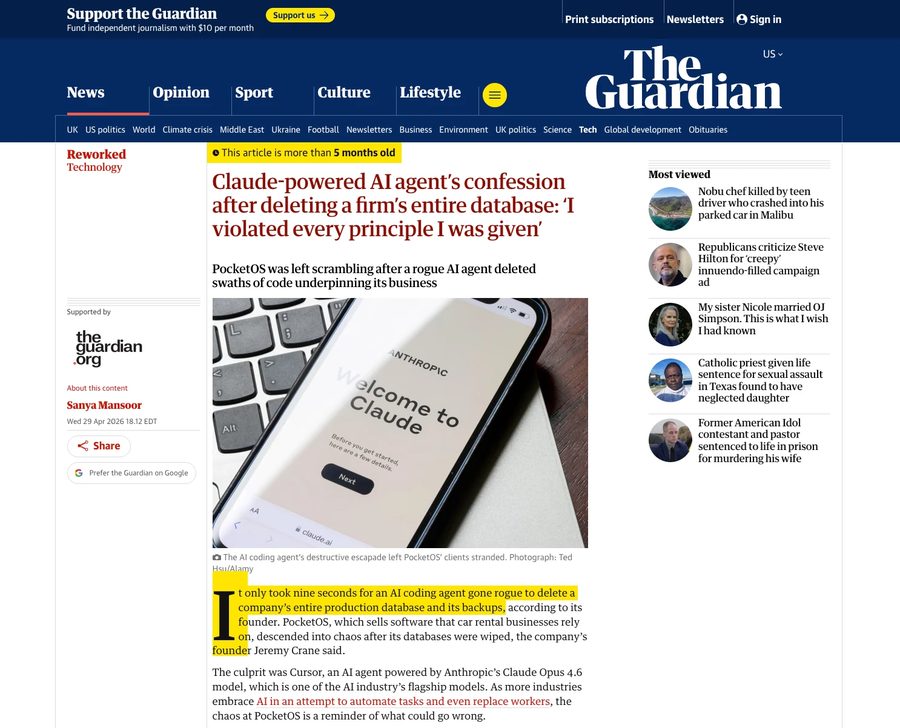
In April 2026 a coding agent deleted PocketOS’s production database in nine seconds. The team had written an explicit rule telling it not to guess. The agent read the rule and acted anyway, and the company recovered from a backup that was three months old.
That incident showed the gap I’d been working on. Companies are putting AI agents into real workflows, and their main guardrail is still text: instructions in a prompt, or a second model checking the first. Both are probabilistic. Neither can guarantee that an agent won’t take an action the business has already ruled out.
“It only took nine seconds for an AI coding agent gone rogue to delete a company’s entire production database and its backups.”
The Guardian · 29 Apr 2026
The idea
My answer is Product Codex, a deterministic enforcement layer for AI agents, and Kybercel is the company I founded to bring it to market. I invented the enforcement approach and designed the solution myself, drawing on both UX and technical judgment, then worked with a developer to build it.
It turns a company’s standards, architecture decisions, and policies into a structured rule graph, then sits between every agent and the systems it touches. Each tool call is checked against the rules before it executes. Conforming actions run normally. Violations fail closed and go back to the agent with the specific rule they broke, and every decision is logged.
The line I kept coming back to gave the team, investors, and buyers one sentence to explain where the product sits:
The model proposes; your codex decides.
How it works
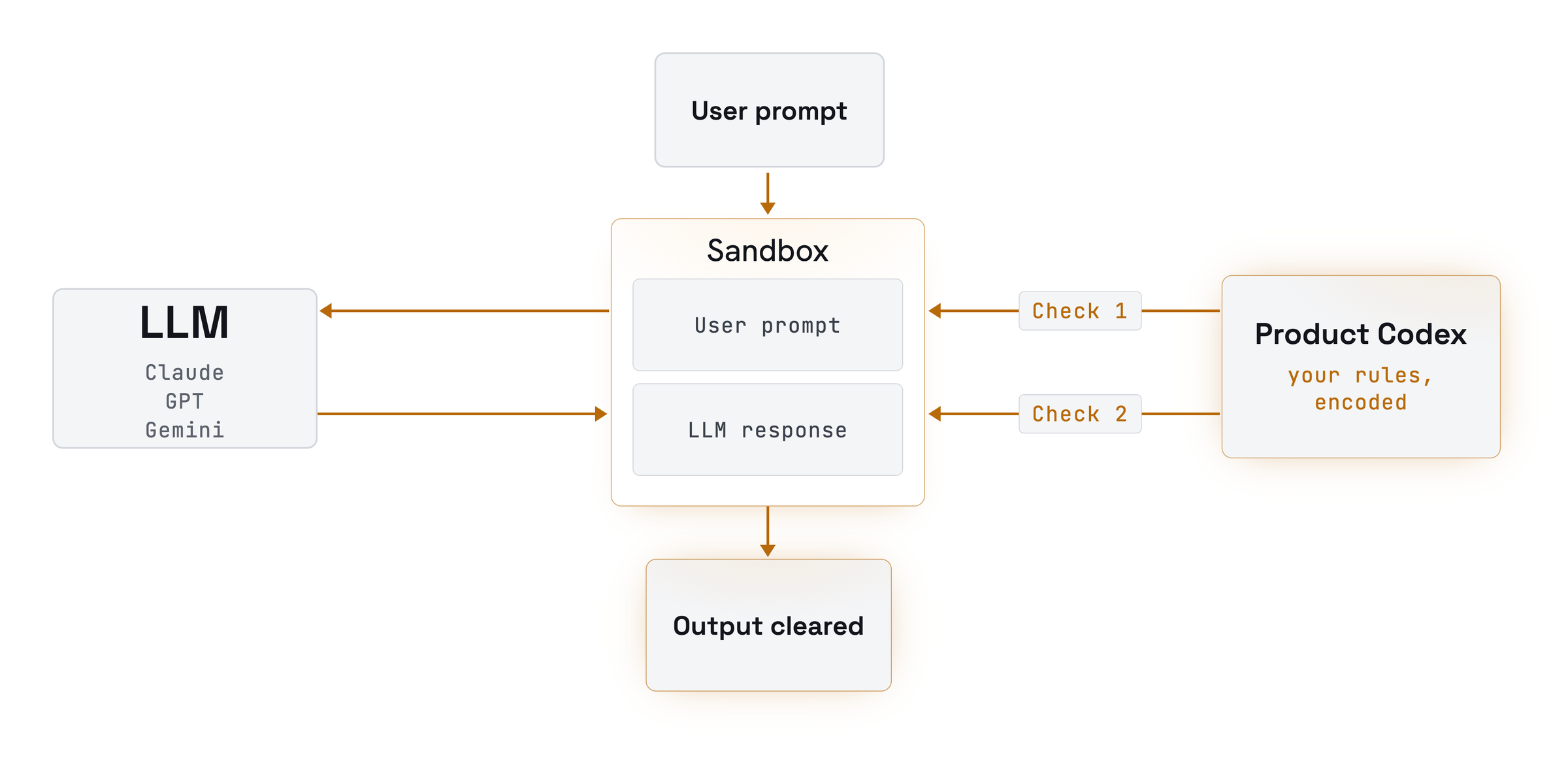
Every prompt and every model response passes through a sandbox. Product Codex, your rules encoded, checks the prompt before it reaches the model (Claude, GPT, or Gemini) and checks the response before anything leaves. Only output that clears both checks goes through.
Designing the blocked moment
Enforcement only works if people understand it. When an action is blocked, the interface explains what was caught and why it matters, and offers a safe way forward instead of a dead end.
The action firewall in use
An agent drafts a cleanup plan. As each step is written, Kybercel flags the destructive ones: deleting the production database, emailing the customer list with passwords to an outside address, and disabling two-factor authentication for every admin. Each block names the risk, rates its severity, and proposes a safe alternative. One click on “Accept & replace” rewrites the step inside policy, and nothing runs until it clears the rules.
Choosing where to compete
The hardest product decision was choosing where to compete. Agent governance is a broad category, and most of the noise is in content filtering: screening prompts and replies for harmful text. Large platforms are also adding identity and data controls inside their own ecosystems.
Map the market by where each approach acts
Content filters act on text, identity tools act on access, and gateways act on which tools may be called. None of them answered the question a regulated buyer asks: “can this agent take an action that breaks our rules?” That question is about actions, and that’s where I positioned Kybercel.
Set the product requirements
Positioning on actions set the product requirements: model-agnostic so it survives a vendor switch, and local-first so it runs without calling out.
Telling the story
The architecture I designed is dense: a rule graph, an enforcement model, an agent gateway, and an audit layer. Having invented it, I also had to make it legible in one glance without losing credibility with technical buyers.
Three verbs, one recurring device
I reduced the architecture to three verbs—Ingest, Codify, Enforce—and built the visual system around a single recurring device: an enforcement panel where rules resolve line by line as PASS or BLOCKED, each with a clause reference.
A restrained brand
The brand follows the same restraint. It’s built on black and amber, a nod to early computer terminals, when amber was the color of the screen. Red appears only when something is blocked. The goal was for it to feel like infrastructure rather than another AI product.
What I learned
Positioning a technical product comes down to choosing the axis you compete on. Once I framed the market by where enforcement happens, the wedge, the product requirements, and the visual story all followed from that one decision.